BioDesign Studio: Living Colors Lab
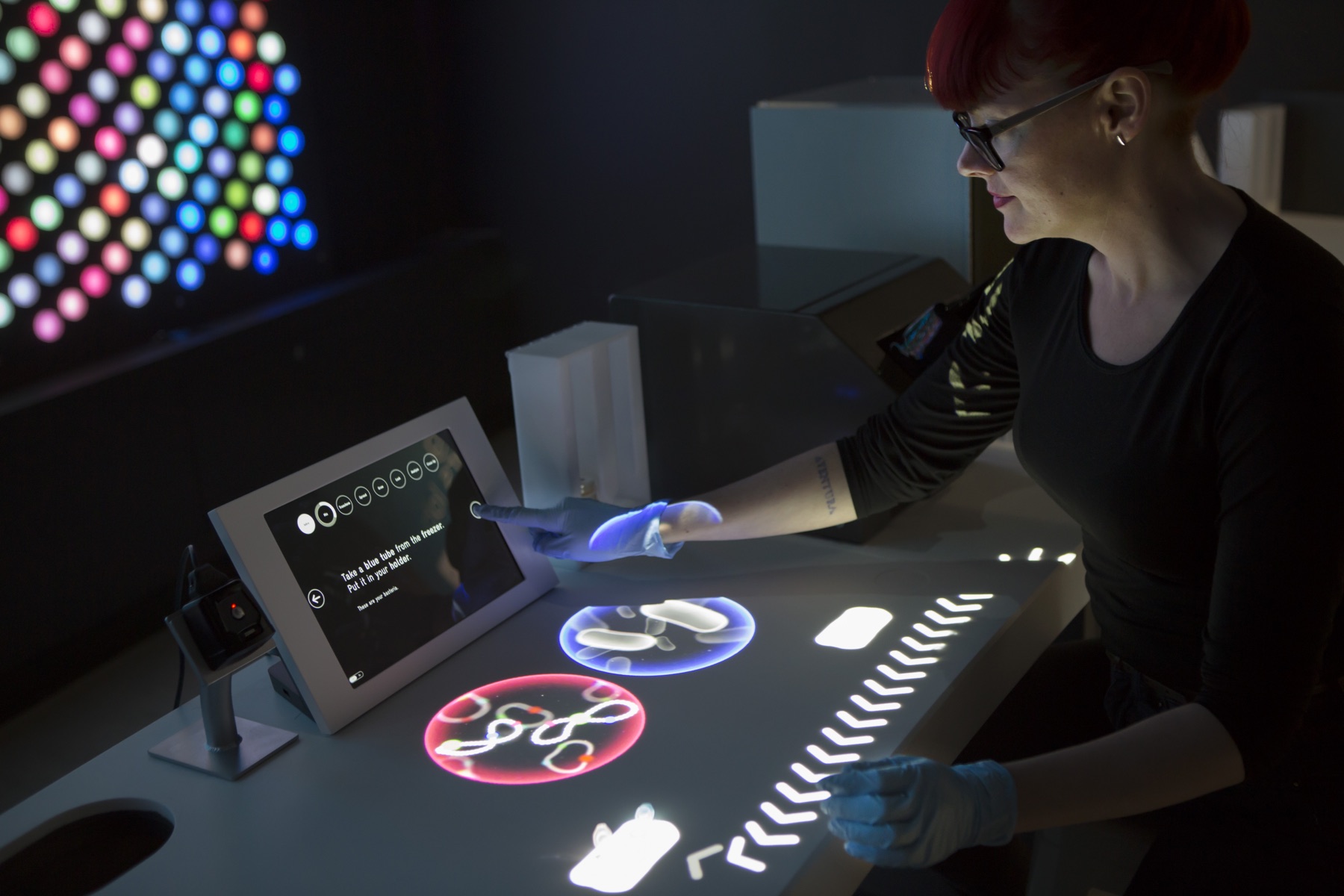
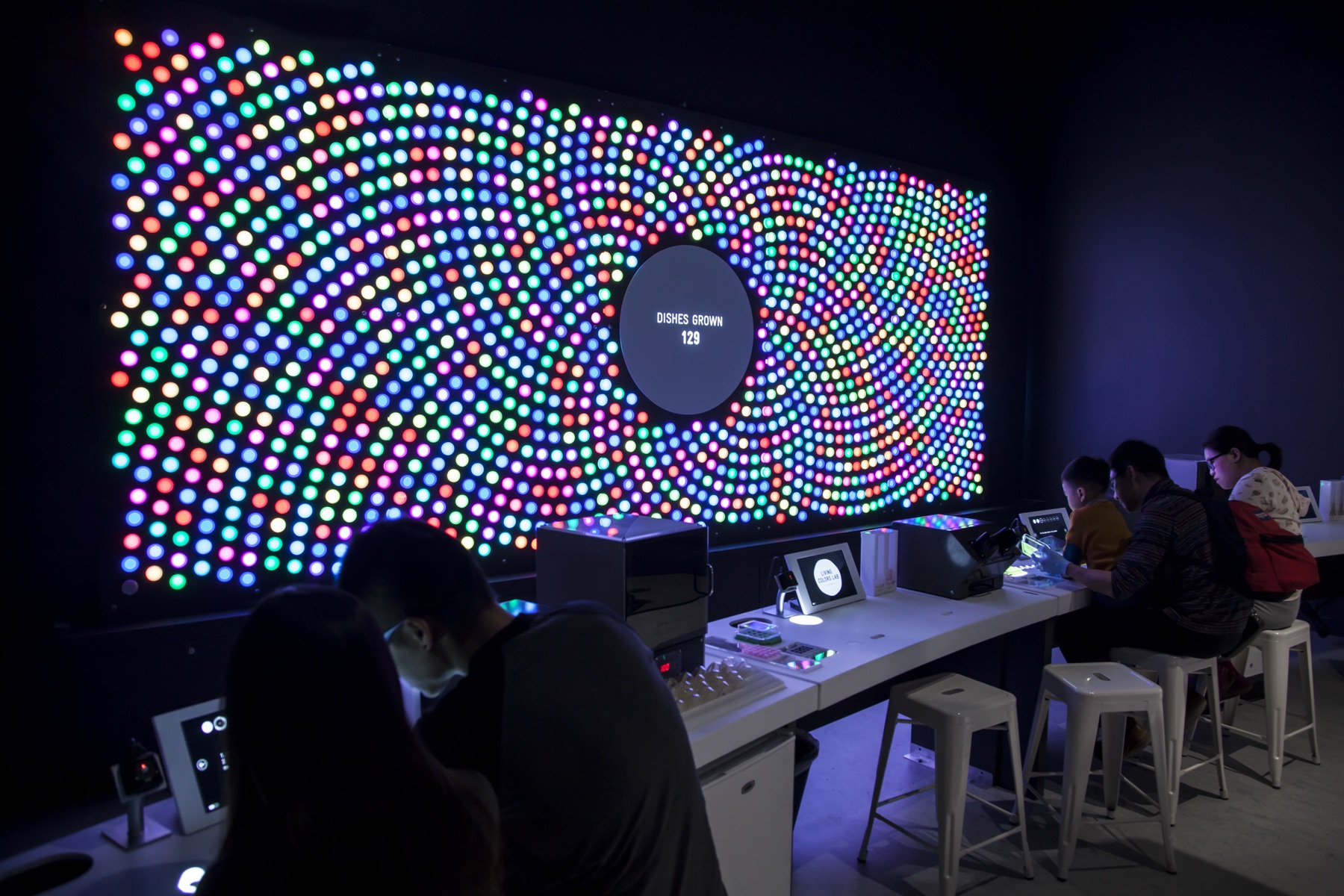
Visitors use tangible tokens to program bacteria to express pigment; successful designs accumulate on an RGB dot wall with a live count of dishes grown.
- Project Director, Concept, Development Lead, Evaluation
- The Tech Interactive (institutional), San Jose
- 2013–2017
- San Jose, CA
- Biodesign and synthetic biology
- Completed
What it is. A station inside BioDesign Studio at The Tech Interactive, the permanent synthetic-biology exhibition that opened March 18, 2016. Visitors handle lab-true tangible tokens to program bacteria to express pigment. Each successful design is added to a large RGB dot wall that keeps a running count of dishes grown, so the room’s collective output is always visible.
The research lineage. The interaction model behind this activity was studied and published as SynFlo with Orit Shaer’s HCI Lab at Wellesley (TEI ‘16). The paper’s framing: the tangible interactions “draw upon the affordances of the labware and imitate physical steps performed by biologists in the lab.” Living Colors Lab is that research as a permanent museum-floor exhibit.
The studio’s role. Project Director, Concept, Development Lead, and Evaluation on the Tech Interactive side; the interactive build was a partnership with Local Projects, with the tangible-interaction research run jointly with Wellesley. The studio overall received AAM Silver MUSE, a D&AD Wood Pencil, and a Core77 Runner-Up in 2017; see the BioDesign Studio page for the full record.
Publications
- Okerlund, J., Segreto, E., Grote, C., Westendorf, L., Scholze, A., Littrell, R., & Shaer, O. (2016). SynFlo: A tangible museum exhibit for exploring bio-design. Proceedings of TEI '16, 141–149. ACM.
Collaborators
- The Tech Interactive, institutional home
- Local Projects, interactive design and build partner (NYC)
- Wellesley HCI Lab (Orit Shaer's group), tangible-interaction research partner (SynFlo lineage)
Related work
-
BioDesign Studio
A permanent exhibition on synthetic biology at The Tech Interactive. A working biological design lab on the museum floor, with tangible-tabletop microbe simulators, live cell-culture stations, and visitor-runnable design tools.